How to frame posters and prints
Posters are fragile and often large. Frame them right and they’ll look better every year.
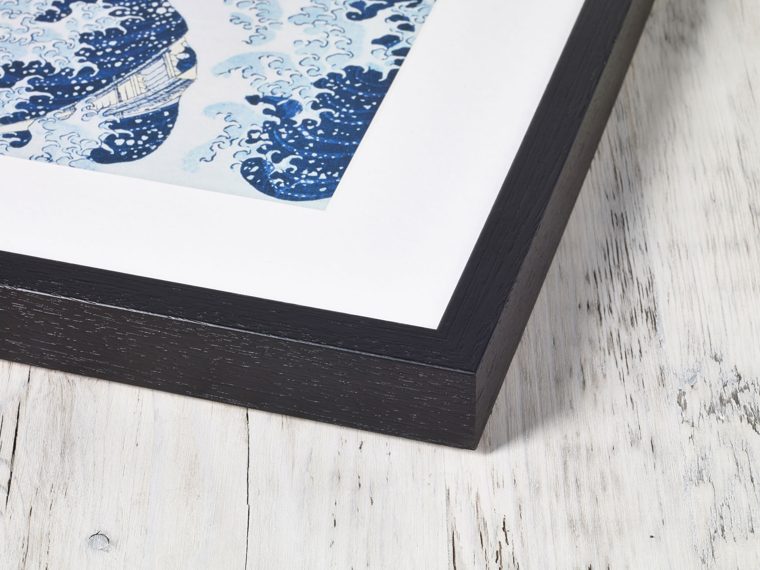
Posters are printed on thin, acidic stock and are often the largest thing on the wall, which is an awkward combination. The size adds weight and flex, while the paper itself yellows quickly in daylight, so glazing and support matter more here than on a small photographic print.
Why posters need more care than they get
Posters are printed on thin, acidic stock, and because they’re so often the largest thing on a wall, small problems become obvious fast. The size adds weight and flex that a rigid backing board needs to counteract, or the sheet will bow inside its frame within a few months. Daylight speeds up yellowing on that thin paper far more than it would on a proper photographic print, so a shaded wall adds years to its life. Because posters stretch across a large area at eye level, a flimsy frame or patchy glazing shows up more than it would on a small print.
Choosing the right frame colour
Thin black metal frames suit gig posters, film one-sheets and anything with bold typography — the black edge reads like a gallery mount and doesn’t compete with the graphic design. White or natural oak frames work better for vintage travel posters and botanical prints, since the pale wood echoes warm, aged paper tones rather than fighting them. Dark grey is a useful middle ground for monochrome photography posters or minimalist prints where black feels too heavy. Avoid gold or ornate finishes on posters altogether; they turn a deliberately graphic, mass-produced piece into something trying to look like a painting.
Quick check: if your poster already has a plain white border printed around the image, frame it directly with no mount at all. Most gig and film posters are designed edge to edge with that border in mind, and stacking a mount on top just doubles up the white space.
Mounts and presentation
For most posters a mount is unnecessary, since the artwork is usually designed to fill its sheet edge to edge. Instead, use a spacer bar — a slim strip set inside the rebate — to hold the poster a few millimetres off the glass, which stops ink transferring onto the glazing over time. If the poster has a plain white border printed around it, frame it directly and let that border do the job of a mount. Only add a proper white or off-white mount when you want to shrink a poster down visually to sit alongside smaller framed prints on the same wall.
Size and proportion
Measure the poster itself, not its packaging, and add roughly 5mm of clearance on each side so the paper isn’t gripped too tightly as it expands and contracts with humidity. Standard sizes like A1 (594×841mm) and A2 (420×594mm) are common, but plenty of gig posters and reissued film art are cut to odd, non-standard dimensions, so treat a custom size as normal rather than a problem. If a poster arrives folded or rolled, let it rest flat for a day or two before measuring, since it settles slightly larger once it relaxes.
Glazing for protection
UV-protective acrylic is the best glazing choice for posters: it blocks the light that yellows thin paper, weighs a fraction of glass, and won’t shatter if a large frame is knocked while being hung. Weight matters more here than on most prints — a full sheet of glass at A1 size or larger adds several kilograms, which strains the wall fixing. Anti-reflective acrylic is worth the upgrade for posters facing a window, since glare off a large flat surface is far more noticeable than on a small photo. Reserve standard glass for smaller posters, A3 and under, where weight isn’t a real concern.
Common mistakes to avoid
Never use tape, glue or spray adhesive to flatten a curled poster onto a backing board — it’s permanent, it eventually shows from the front, and it makes reframing impossible later. Framing a poster flat against the glass without a spacer is the other common mistake: over months the ink can soften and bond lightly to the glazing, and pulling them apart tears the surface. Framing a poster immediately after unrolling it, without letting it flatten first, leaves a visible curve at the edges that never fully relaxes. If a poster arrives creased, resist ironing or heating it; a framer can flatten it properly with gentle, even pressure instead.
Frequently asked questions
Do posters need a mount?
Usually not — most posters are designed to fill their sheet edge to edge, so a mount can crowd out part of the artwork. Instead, use a spacer bar inside the frame to hold the poster a few millimetres off the glass, which stops ink sticking to the glazing over time. A plain white mount can still be added if you want a poster to sit visually alongside smaller framed prints on the same wall.
What glazing for posters?
UV-protective acrylic is ideal for large posters, since it blocks the light that yellows thin paper and weighs far less than an equivalent sheet of glass. That reduced weight also makes it shatter-resistant and easier to hang safely at sizes like A1 or above. For smaller posters, A3 and under, standard glass is perfectly fine if weight isn’t a concern.
How to flatten a poster without damage?
Never use tape, glue or an iron to flatten a curled or creased poster — heat and adhesives cause permanent damage that shows up later. Instead let it rest flat under light, even pressure for a day or two, ideally between sheets of archival tissue, and the curl usually relaxes on its own. For a poster that’s badly creased or has been rolled for a long time, a professional framer can flatten it properly with controlled pressure.
Related guides
How to frame mixed media and art prints • Which frame material should you choose? • What is a photo mount and why does it matter?
How Emblem Frames helps
At Emblem Frames we remove the guesswork. Upload your photo and our AI analyses colour, subject and mood, then suggests the ideal frame colour, mount and finish. You see a realistic preview before you buy, so you know exactly how it will look on your wall. It’s made-to-order, delivered ready to hang across the UK, with no account needed.